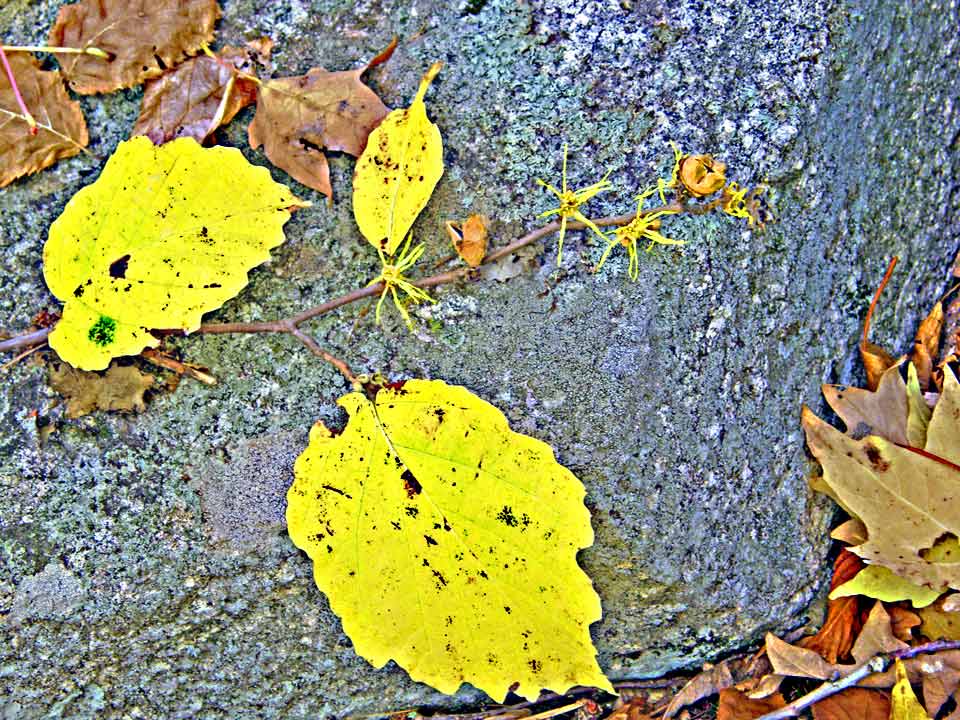
Photo taken recently on Shannon Mt in the Belknaps. This is a common shrub of the Lakes Region area which has a long history of use by man on several continents. Its fruit, flowers, and next year's leaf buds all appear on the branch simultaneously, a rarity among trees. Each flower has four very-narrow yellow petals The leaves, somewhat lop-sided in appearance, have a wavy margin. The flowers are sometimes produced on the leafless stems in winter, providing an alternative name for the plant, "Winterbloom". Around here the flower is usually seen in the fall, the latest of wild flowers of this area to bloom. The seed capsule (2 seen here) contains 2 seeds (said to be edible) and after a long period of drying out opens explosively, casting the seeds a significant distance, thus spreading the plant throughout the woods. Extracts from its bark and leaves are often used as an astringent in aftershave lotions and lotions for treating bruises and insect bites. It is also the active ingredient in many hemorrhoid medications. In former times bottles of the extract were frequently found in New England homes as it was considered an important element of the medicine cabinet for the treatment of many common ills. It has been claimed that more witch hazel is used than any other botanical ingredient in the world, including Aloe. The term witch is a corruption of the Old-English name wiche, which meant 'bendable' - this bendable feature of the plant has caused it to be often used as a divining rod for trying to locate a good place to dig a well for water. A web site of products containing witch hazel extract: www.whazel.com/products.htm
· Date: Wed October 22, 2008 · Views: 2906 · Filesize:32.0kb, 130.5kb · Dimensions: 960 x 720 ·
Additional Info
Linked Thumbnail:
Linked Medium: Medium Image: HTML code: Direct link:
Author
Thread
Rattlesnake Gal Senior Member
Registered: November 2003 Location: Central NH Posts: 5,253
Wed October 22, 2008 6:15pm
Thanks DCR. You always have such interesting pictures and fantastic information.

 Winnipesaukee Forum